Over the past few weeks, a post by LinkedIn’s Chief Product Officer Hari Srinivasan has sparked a lot of discussion. LinkedIn is deploying a new generation of AI classifiers to identify so-called “AI Slop” and limit its distribution. In addition, users can report posts they believe consist primarily of low-quality, AI-generated content.
I understand that decision. Since the rise of generative AI, the amount of content on LinkedIn has exploded. Today, anyone can produce a complete thought leadership post within seconds. That lowers the barrier to publishing, but at the same time, it creates an enormous amount of mediocre content. For a platform built around knowledge sharing and professional reputation, that is a logical challenge to address.
Still, the chosen solution also raises questions.
LinkedIn is using AI to detect AI. On paper, that sounds logical, but in practice, it is one of the most difficult AI challenges there is. After all, an algorithm does not know how a text was created. It does not know the author, nor can it assess intent. It only looks at language patterns, sentence structures and statistical probabilities. As a result, there will always be a risk that completely authentic content is incorrectly identified as AI-generated.
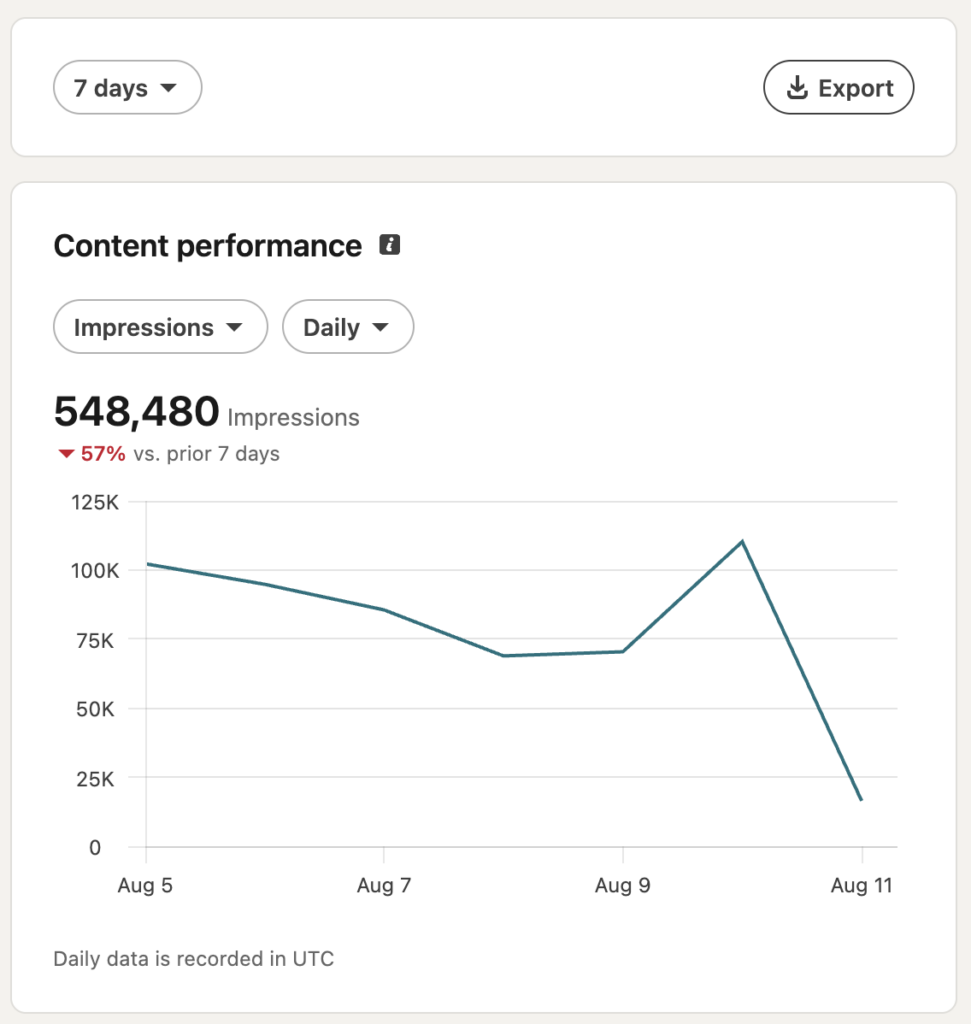
I am already seeing clear changes in my own statistics. Over the past seven days, my total number of impressions dropped by 57%. It is important to note that this period still partially includes the performance of posts from the previous week. So it is too early to draw firm conclusions, but it does seem to confirm that LinkedIn is changing the way it evaluates content.
At the same time, I am seeing something else. Good, authentic content can still perform extremely well. That may be the most important conclusion. Reach has not disappeared, but the rules of the game do seem to be changing.
Interestingly, videos with little or even no accompanying text currently seem to perform relatively well. That is concerning. Over the past few years, LinkedIn has developed into the platform for thought leadership, in-depth analysis and knowledge sharing. If videos with little context consistently start outperforming in-depth articles, the character of the platform could gradually shift towards a model that feels more like TikTok. That would be unfortunate, precisely because LinkedIn has always distinguished itself through the quality of its content.
I am also increasingly seeing examples of content that I know to be authentic, but whose distribution seems to follow the same pattern as posts that may be getting suppressed by AI classifiers. Of course, this is not proof that LinkedIn is actually classifying these posts as AI-generated, but it does show how complicated this issue is. If writers start changing their choice of words simply to avoid sounding like AI, we end up with exactly the opposite of what LinkedIn is probably trying to achieve. Creativity is no longer encouraged; it is restricted.
What strikes me most, however, is that the discussion has increasingly become about AI itself, while I do not think that is the right discussion to have.
AI is no longer something we can separate from marketing. Almost every marketer now uses AI for research, brainstorming, spell-checking, video editing, image optimisation or refining copy. That is not a threat, but a logical technological development. In fact, I think that within a few years, not using AI at all will feel as outdated as not owning a smartphone.
That is why it is important to distinguish between AI Slop and AI Enhancement.
AI Slop consists of generic content without an original point of view, personal experience or added value. AI Enhancement is the exact opposite. The idea, opinion and experience still come entirely from the creator, while AI is used to improve the content. Think of sharpening a headline, improving the structure, correcting grammar or optimising a video. The content remains human; only the tools change.
In my view, that distinction should play a much more central role in the discussion.
I also do not see the ability to report posts as AI Slop as the biggest risk. Most users simply will not take the time to randomly report posts. Of course, there will be situations where competitors try to undermine one another, but I do not expect this to determine content reach on a large scale.
The real risk lies in automated classification. When millions of posts are assessed by AI models every day, even a small degree of inaccuracy can have enormous consequences. If authentic content is incorrectly classified as AI-generated, it directly affects the visibility of good creators.
I therefore expect LinkedIn to continue refining its classifiers over the coming months. And that is necessary. Ultimately, the question should not be whether AI was used, but whether a post actually adds value.
AI is here to stay. The challenge for LinkedIn is therefore not to ban AI, but to reward quality. Bad content will eventually disappear because people do not read it, share it or find it interesting. Good content does exactly the opposite.
Perhaps that is still the best form of quality control.
Not an AI classifier, but the people reading the content.